Professional development does not end when a training course is completed.
The real question comes afterward: How do teachers use what they have learned in their own classrooms?
As part of the MoEYS STEP UP Continuous Professional Development (CPD) program, Core Trainers visited schools in Kampong Thom and Stung Treng to work directly with teachers through coaching and mentoring.
The focus was not simply to repeat what had already been covered in training. It was to look at how teachers were applying Curriculum Literacy, Competency-Based Learning, STEM Learning, and outcome-based lesson design in actual teaching practice—and to identify where further support was needed.
Starting with the curriculum
One important part of the coaching was helping teachers return to the curriculum itself.
Physics teachers, for example, reviewed curriculum goals, objectives, and expected learning outcomes and examined how these could be connected through Backward Design. They worked through the relationship between intended learning outcomes, assessment evidence, and lesson planning rather than treating them as separate elements.
Math and ICT teachers also developed lesson plans based on real curriculum topics. They revisited the 5E instructional model, problem-solving approaches, and outcome-based planning, and then applied them to topics such as quadratic equations.
This is where Curriculum Literacy becomes practical: teachers are not simply reading a curriculum document, but using it to make decisions about what students should learn, how learning should happen, and how it should be assessed.
Turning STEM into classroom practice
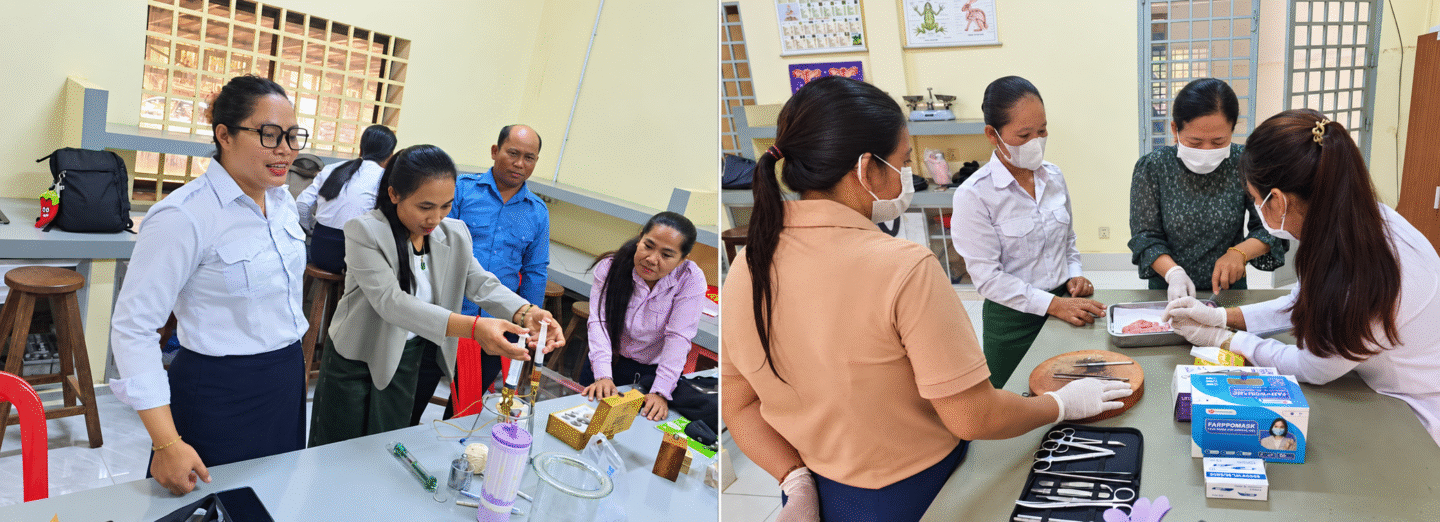
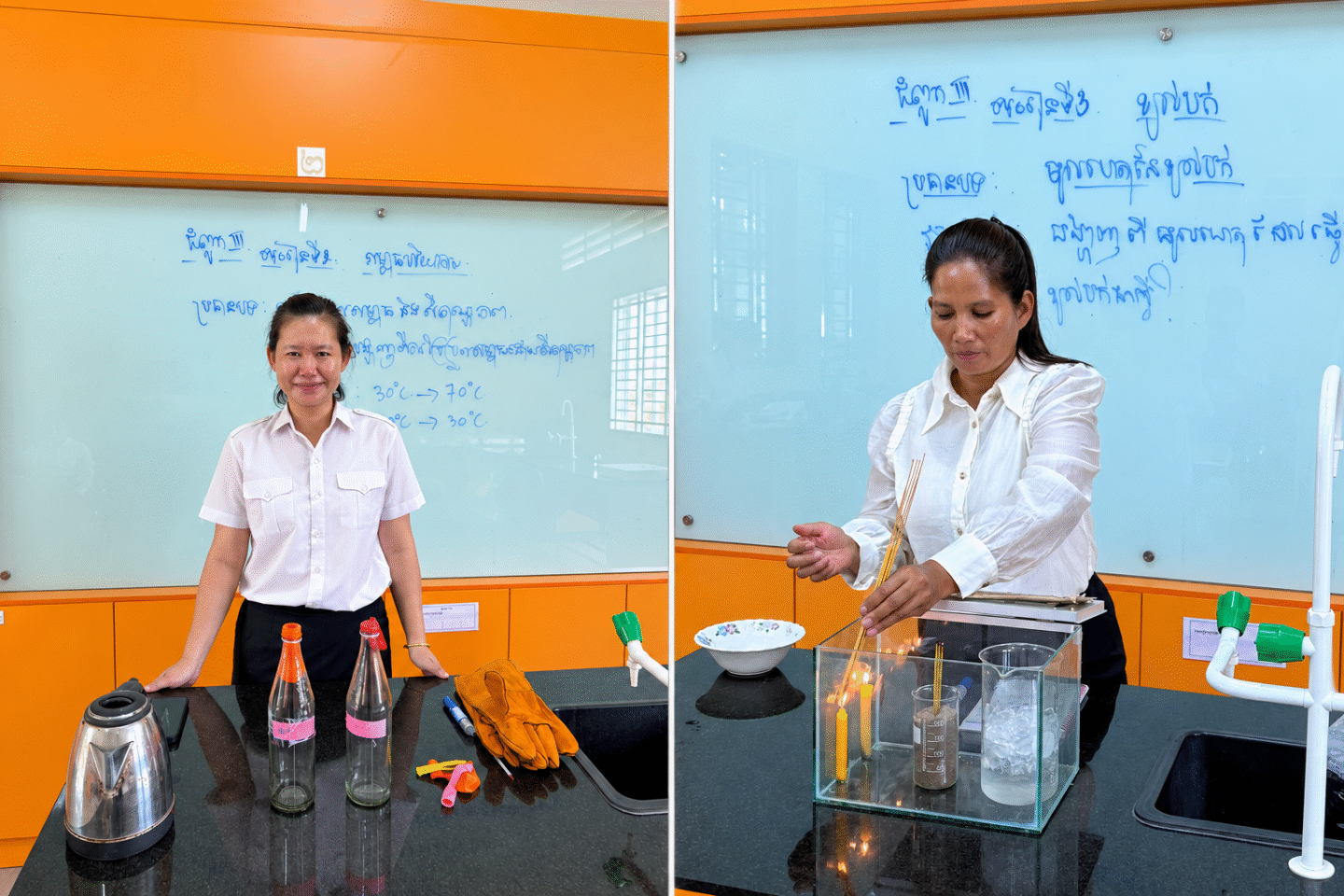
For science teachers, the coaching moved directly into laboratories and practical activities.
Teachers selected experiment topics, checked available equipment, prepared worksheets, conducted experiments, and reviewed how those activities could be used in their own lessons.
At Kampong Thom, physics teachers carried out experiments on topics including transformers, Ohm’s Law, and electric motors. Biology teachers worked on curriculum-related experiments involving photosynthesis, osmosis, enzymes, and other topics across Grades 10 to 12.
In Stung Treng, physics teachers worked with experiments including Pascal’s principle, gas expansion, and compass construction. They also developed and revised experiment worksheets with support from Core Trainers.
The purpose was not simply to complete an experiment successfully. Teachers needed to consider how the activity could become part of a lesson that they could realistically repeat with their own students.
Coaching also reveals what training alone cannot
Working in schools also makes practical challenges visible.
In several activities, teachers reported shortages of laboratory materials and difficulties obtaining equipment. In some cases, teachers adapted locally available materials or worked together to find alternatives.
Access to technology was another recurring issue. Not every teacher had a computer, and some had limited experience with digital tools. Teachers sometimes worked in pairs or groups, shared devices, used mobile internet, and relied on screen-recorded demonstrations so they could continue practicing after the session.
These are important findings because they show that effective professional development is not only about introducing a teaching method. It also requires understanding whether that method can actually be used in a teacher’s working environment.
Creating, reviewing, and improving teaching materials
The coaching also extended into digital teaching practice.
Teachers used tools such as CapCut, Lumi, and H5P to edit instructional videos and develop interactive learning materials.
In Stung Treng, math and ICT teachers completed Backward Design plans, recorded teaching videos, and then practiced turning those videos into interactive H5P learning materials.
Not every activity was completed within the available time. Limited computer access, differences in ICT confidence, and the pace of the sessions meant that some teachers needed additional practice. Follow-up tasks and continued support were therefore included as part of the next steps.
What happens after training matters
The coaching and mentoring sessions showed why follow-up support matters.
Teachers need opportunities to read the curriculum more closely, design lessons, try new approaches, identify what does not work, make adjustments, and try again.
That process is what allows Competency-Based Learning and STEM Learning to move from professional development into everyday teaching.
Under the MoEYS STEP UP CPD program, NIE and Core Trainers are continuing to support teachers through this process, with support from EMCAST.