Next week, the science labs at Kampong Thom High School are going to get unusually crowded.
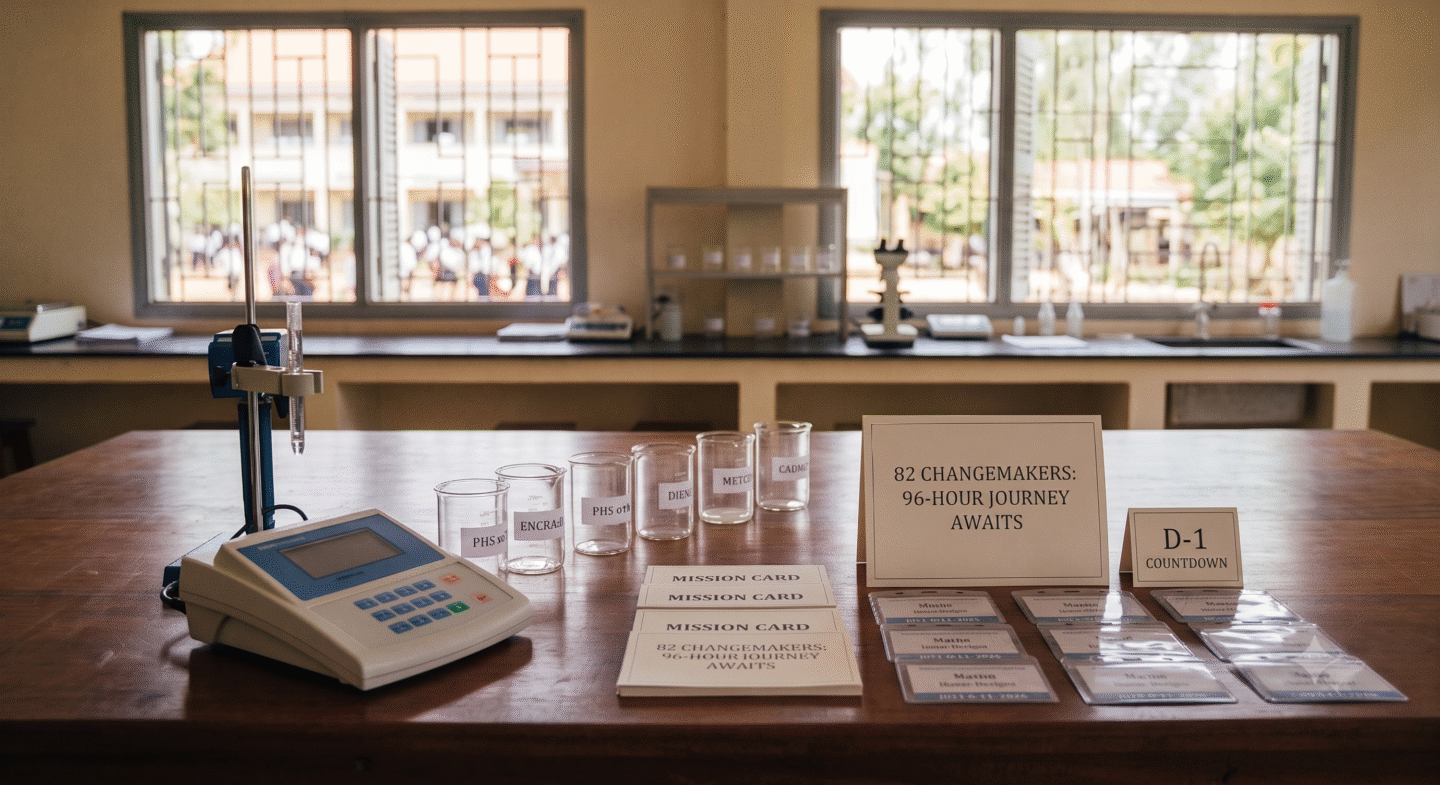
From July 8 to 11, 2026, eighty-two educators are doing something that requires a fair amount of courage: they are stepping away from the whiteboards, putting down the chalk, and taking a seat at the laboratory bench as students.
Kampong Thom is a fascinating backdrop for this. Known as the geographical heart of Cambodia, it’s a region layered with history – home to the ancient, centuries-old brick engineering of Sambor Prei Kuk – yet deeply tied to the daily, practical rhythms of agriculture and the nearby Tonle Sap lake. It is a place where science isn’t just an abstract concept in a textbook; it’s woven into the water, the soil, and the community’s livelihood.
And next week, it becomes the testing ground for a very quiet, very deliberate shift in science education.
Shifting Focus to the Mechanics
This four-day workshop isn’t about high-level educational philosophy or lecturing teachers on abstract theories. Instead, it’s a deep dive into the gritty, hands-on mechanics of running a functional science lab.
The cohort is a diverse mix. We have 51 educators from Kampong Thom High School and 31 from Hun Sen Ballang High School, ranging from veteran biology and physics teachers to school directors and lab assistants. For four dense days, their focus will narrow down to the fundamentals: the precise calibration of equipment and the step-by-step execution of scientific protocols.
“Effective STEM education doesn’t happen through lectures alone; it happens through constant, hands-on refinement.”
The schedule waiting for them is rigorous. Guided by National Institute of Education (NIE) frameworks, these teachers will spend their first few days analyzing lab guidelines, proposing practical experiments that actually matter to local students, and carefully labeling materials. They won’t just perform the experiments – they will be capturing them on camera, creating ‘flipped learning’ video guides so their students can preview the practical steps at home before ever touching a beaker in class.
Designing with the End in Mind
As the week progresses, the training shifts from the physical lab to the digital domain. The educators will be diving into Backward Design – a curriculum framework that asks teachers to start with the final destination. Instead of asking “What chapter comes next?”, they will ask, “What real-world concept do my students absolutely need to understand, and how do we prove they’ve learned it?”
From there, the labs will turn into makeshift production studios. Armed with laptops and ICT tools, the teachers will draft scripts and edit Interactive Videos – educational content where lessons aren’t just watched, but engaged with through mid-video questions and choices.
By the final day, they’ll even be designing their own survey tools to evaluate the effectiveness of the training itself, ensuring that what happens next week leaves a lasting framework for the future.
The Art of Constant Refinement
There is something deeply respectable about a teacher who is willing to say, “Let me double-check my own alignment.” Seeing a physics teacher spend an afternoon revisiting wave mechanics, or a chemistry teacher obsessing over the exact recalibration of a solution, is a reminder of what good teaching actually costs.
It takes time, effort, and a willingness to be wrong.
Next week, we will be on the ground in Kampong Thom, quietly documenting this process of learning, coaching, and digital creation straight from the school labs. We can’t wait to see what these 82 educators build.